This essay accompanies Episode 3 of Rebecca's Third Act. [Watch the video here](link to YouTube video)
Are you struggling to find your role in responding to ongoing crises? For years, I felt that tension—wanting to contribute, showing up when I could, but never quite sure where I fit in the larger movement for change.
Then, during Trump's first term, I encountered a diagram that changed how I think about activism entirely.
The Diagram That Named My Work
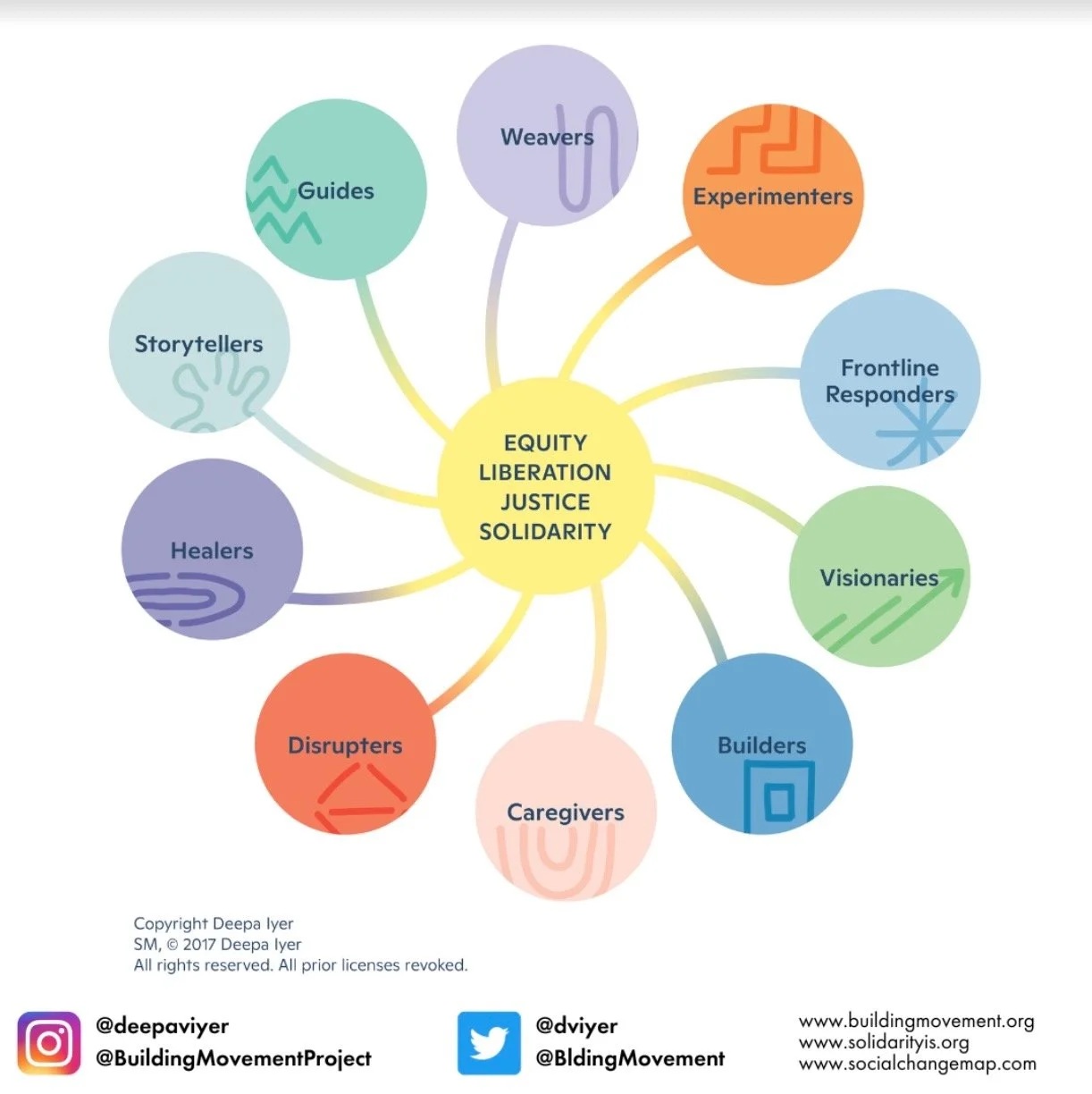
Deepa Viyer's social change ecosystem diagram maps out the various roles people play in movements for justice. Unlike the oversimplified binaries I'd seen before (organizer or follower, leader or supporter), this framework offered nuance. It showed me that movements need:
Weavers who build and sustain community
Frontline responders who meet immediate needs
Storytellers who shape narrative
Healers who tend to trauma and harm
Bridge builders who translate across difference
Experimenters who pilot new approaches
Guides who teach and mentor
When I saw "weaver" on that diagram—someone who connects people, builds coalitions, and creates the conditions for collective action—something clicked. That's me. That's what I've always done.

A Career of Weaving
Looking back, I can see the pattern clearly. Whenever I want to make something happen, I start by gathering the right people.
When I first moved to the Bay Area wanting to direct plays, my first move was to gather a group of artists and produce a show in the San Francisco Fringe Festival. After that show, we decided to start a theater company together. Crowded Fire Theater is still producing work almost 30 years later.
That's weaving: bringing people together to achieve things no single person could accomplish alone.
My biggest professional achievements have all been collective ones, goals that could only have been achieved by people working together.
Weaving in Response to Crisis
During Trump's first term, I started hosting a monthly political action group. We eventually merged with another Berkeley group, and together we've been meeting every month since early 2017. Over the years we’ve evolved a shared leadership structure, with six of us sharing responsibility for convening the group and selecting actions . We've taken local and national actions regularly, raised hundreds of thousands of dollars for Democratic candidates and grassroots voting organizations, and provided a safe starting place for many new activists.

This is how weaving works: bringing people together regularly to form community and take collective action. The power isn't in any single action we take—it's in the consistency, the relationships, the infrastructure of trust we've built over years.
The Scale of Weaving: From Neighborhood Chats to National Movements
Here's what I've learned about weaving: it doesn't require grand gestures or years of commitment. You can weave at any scale.
Early in Trump's second term, I decided my block needed a neighborhood group chat. Some neighbors I knew well; others had moved in recently and I'd never met. I went door to door collecting phone numbers and created a neighbor group chat.
That small act of weaving has created real community. We've helped someone find a lost dog, dealt with maintenance emergencies together, and alerted each other about ICE sightings in the area. We know each other's names now. We look out for each other.
Micro-activism counts. Starting a group chat, connecting two people who should know each other, hosting a regular gathering, forming a book club that tackles difficult topics—these are all acts of weaving. You don't need to organize a march or start a nonprofit. You just need to create space for people to come together.
Weaving as Women's Work
I love the weaver metaphor partly because weaving is traditionally women's work. There's power in claiming that history—the patient, skilled, essential labor of creating connection and structure. The work that holds communities together. The work that's often invisible and under-appreciated.
Weaving requires attention to detail that can feel mundane: checking in on people, making sure everyone knows each other's names, asking "should we meet again this month?", noticing who's been quiet lately. This emotional and logistical labor is often undervalued, dismissed as less important than the "real work" of organizing.
But without weavers, movements fall apart. Without people tending relationships, communities fragment. The flashy actions get attention, but sustainable change requires the steady work of connection.
Weaving Beyond Theater Spaces
As I've leaned into this role in my activism, I've started wondering how it connects to my artistic practice. Obviously, assembling a theater ensemble is a form of weaving. But I'm increasingly drawn to work that happens outside conventional theater spaces—work centered on the act of weaving strangers into community.
I'm developing a project called the Artists' Constitutional Convention. I don't know much about it yet, but I know it will invite artists to reimagine what a constitutional convention could be. And I know it will be participatory—both in its creation and its eventual presentation.
This feels like the natural evolution of my practice: using the tools of theater not to create performances for passive audiences, but to facilitate collective imagination and action.
Finding Your Own Role
Understanding that I'm a weaver has changed how I show up in both activism and art. It's helped me stop trying to do everything, recognize my limits, and appreciate where I'm most effective. It's also helped me value the work I do instead of dismissing it as "just" connecting people or "just" facilitating.
The Deepa Viyer diagram includes many other roles, and movements need all of them. We need frontline responders and healers. We need storytellers shaping narrative and guides teaching skills. We need experimenters piloting new approaches and bridge builders translating across difference.
The question isn't whether your role is important enough. The question is: which role allows you to contribute sustainably? Where do your skills and inclinations meet the movement's needs?
Sustainable Activism Requires Role Clarity
One reason people burn out in activism is trying to do everything. We think we should be at every protest, make every phone call, attend every meeting, donate to every cause. But sustainable engagement means finding your lane and staying in it—while trusting others to fill the roles you can't.
I'm not a frontline responder rushing to meet immediate crises. I'm not a healer tending to trauma (though I deeply value that work). I'm a weaver. I show up consistently, I connect people, I hold space for collective work. That's my contribution, and it's enough.
Knowing your role also helps you find your people—others who share your approach or who complement your skills. It helps you build the coalitions and collaborations that make movements work.
What's Your Role?
If you're trying to figure out where you fit in movements for change, I encourage you to explore the full social change ecosystem. [Link to Deepa Iyer's work if available]
Ask yourself:
What comes naturally to you?
What do people already come to you for?
What work feels sustainable rather than depleting?
Where do you see gaps that match your skills?
You don't need to force yourself into a role that doesn't fit. The movement needs you exactly as you are—doing the work only you can do, in the way only you can do it.
Weaving Forward
I'm still figuring out what it means to center weaving in my creative practice. How does understanding access, community, and collective action change how I make theater? What projects become possible when I lead with connection rather than performance?
These are the questions I'm sitting with as I plan this third act. If you're navigating similar territory—trying to align your creative work with your values, finding sustainable ways to contribute to change, or just figuring out where you fit—I'd love to hear from you.
What role do you play? What does weaving (or storytelling, or healing, or experimenting) look like in your life?
Let's keep the conversation going.
Rebecca's Third Act is a video and blog series documenting my midlife reboot—reimagining life, art, and purpose as a theater maker, parent, and activist navigating change. Subscribe to the YouTube channel and follow along as I figure out what's next.
Interested in support for your own third act? Learn about Third Act Lab, an 8-week coaching cohort starting in January.